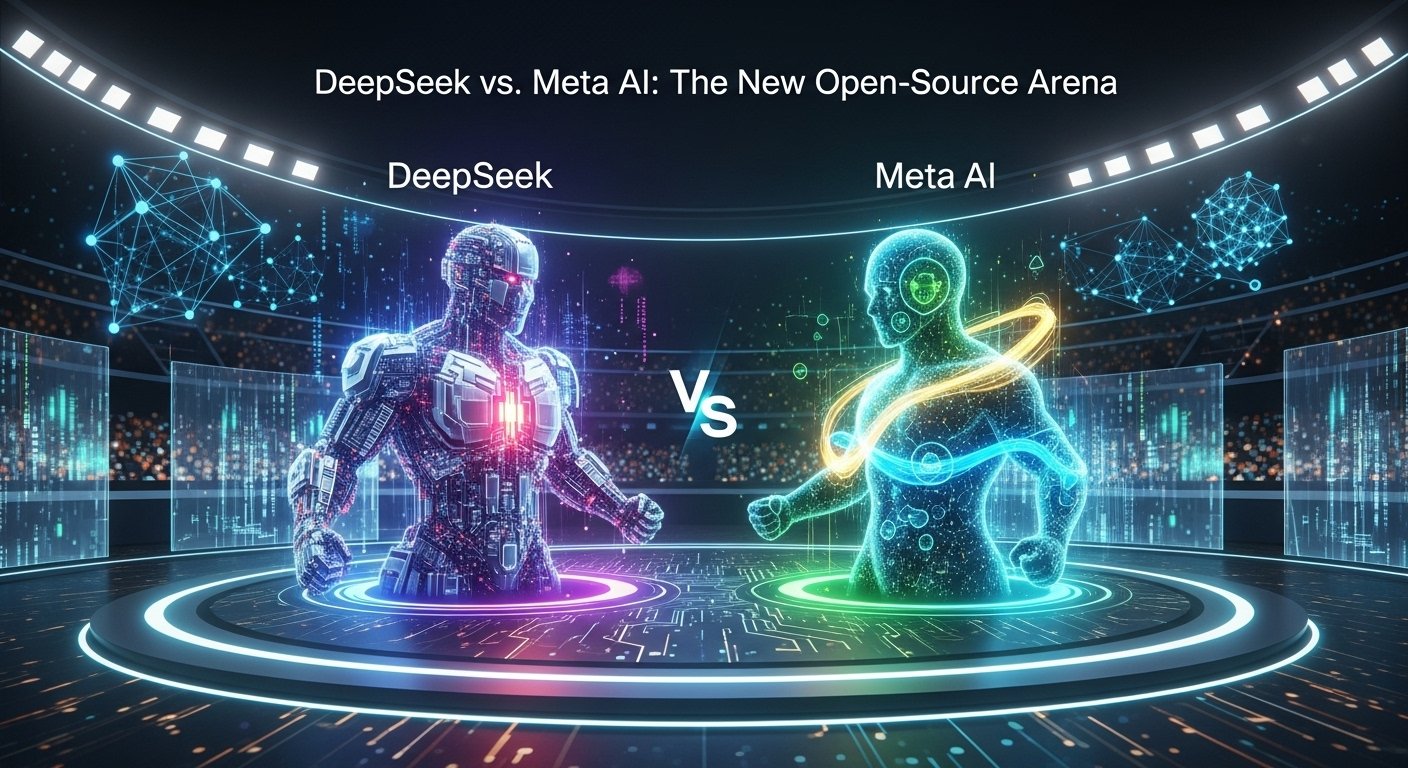
The artificial intelligence landscape is no longer defined solely by a race for raw performance. A new, more fundamental battle is underway, a clash of ideologies, strategies, and economic models that will shape the future of accessible AI. At the heart of this conflict are two titans of the so-called “open-source” movement: DeepSeek, a hyper-efficient Chinese disruptor born from the high-stakes world of quantitative finance, and Meta AI, the Silicon Valley incumbent leveraging its colossal scale to build a global AI ecosystem. This is the new arena, a contest that pits a lean, cost-obsessed David against a strategic, ecosystem-building Goliath.
This report moves beyond simple benchmark comparisons to provide the definitive, data-backed analysis of this emerging rivalry. It dissects their foundational philosophies, deconstructs their technical architectures, scrutinizes their controversial licenses, and evaluates their real-world impact and hidden risks. This analysis is designed to equip developers, business leaders, and researchers with the deep understanding needed to navigate this new open-source arena and make informed strategic decisions. The journey will take us from their corporate origins and technical deep dives to their market impact, culminating in a final, actionable verdict on how to choose a champion.
I. The Contenders: A Tale of Two Foundational Philosophies
The stark differences in the technology and market strategy of DeepSeek and Meta AI are not accidental; they are a direct consequence of their profoundly different origins and core business objectives. One was forged in the crucible of financial arbitrage, obsessed with efficiency and exploiting market inefficiencies. The other was born from a long-term academic vision, focused on platform dominance and shaping the global technological landscape.
A. DeepSeek: The Lean, Cost-Obsessed Disruptor from the East
DeepSeek’s story begins not in a university research lab, but within High-Flyer, a Chinese quantitative hedge fund founded by Liang Wenfeng. This origin is the Rosetta Stone for understanding its entire corporate DNA. The company’s culture is rooted in the ruthless, efficiency-driven world of algorithmic trading, where success is defined by identifying and exploiting market inefficiencies for profit.
The pivotal moment came in 2021 when the Chinese government initiated a regulatory crackdown on high-frequency speculative trading. This prompted Liang to pivot a team of researchers toward fundamental AI, a move that led to the spin-off of DeepSeek in July 2023. From its inception, DeepSeek’s strategy has been a direct translation of its financial market origins: to achieve state-of-the-art (SOTA) performance at a fraction of the cost of its Western rivals. The reported training cost of just $6 million for its R1 model, compared to an estimated $100 million for OpenAI’s GPT-4, is not merely a budget line item; it is the company’s central competitive advantage and a direct challenge to the industry’s prevailing “brute-force spending” paradigm.
This philosophy of frugal innovation permeates every aspect of its operations. The company operates with a lean team of approximately 200 employees, often hiring top talent fresh from Chinese universities. It has invested heavily in co-designing its own hardware and software stacks, building custom computing clusters like Fire-Flyer 1 and Fire-Flyer 2. This allows for deep optimization and, critically, enabled the company to continue training effectively even when faced with trade restrictions on the most powerful AI chips from the U.S..
B. Meta AI: The Incumbent’s Ecosystem Gambit
In stark contrast, Meta AI’s lineage traces back to Facebook Artificial Intelligence Research (FAIR), founded in 2013 under the guidance of AI luminary and Turing Award winner Yann LeCun. Its philosophy is not one of cost-saving but of strategic, long-term influence, rooted in a deep-seated belief in open research and community collaboration.
Meta’s primary strategic objective with its Llama series is not to sell models but to prevent a single proprietary entity, namely OpenAI, from achieving a monopolistic hold on the AI landscape. By releasing powerful models like Llama with a permissive license, Meta aims to commoditize the foundational model layer. This classic platform-building strategy encourages a vast ecosystem of developers, startups, and enterprises to build upon its technology, making Llama a de facto global standard. In this scenario, Meta wins by ensuring its continued relevance, access to diverse data streams, and influence over the direction of AI development.
This grand vision is backed by an investment and infrastructure scale that dwarfs DeepSeek’s. Meta operates a global network of massive data centers and has built its own custom AI Research SuperCluster (RSC). The company’s training approach has evolved to handle unprecedented scale, shifting from jobs running on 128 GPUs to massive pre-training runs requiring 4,000 GPUs or more. With plans to invest $60-65 billion and build a new data center consuming over two gigawatts of power, Meta is signaling its clear intention to win this race through overwhelming scale and resources.
The core philosophies of DeepSeek and Meta AI are, therefore, not just different; they represent diametrically opposed strategic bets on the future of AI. DeepSeek is executing an efficiency arbitrage strategy, identifying that the AI market mistakenly equated performance with exorbitant cost and building a business model to exploit that inefficiency. Meta, meanwhile, is playing a long game of ecosystem dominance, leveraging its immense resources to build a foundational platform that it hopes will underpin the next generation of AI applications. This fundamental divergence in their corporate DNA is the source of every subsequent difference in their architecture, licensing, and market approach.
II. Under the Hood: A Clash of Architectural Masterpieces
The competing philosophies of DeepSeek and Meta AI are directly reflected in their models’ underlying architectures. DeepSeek has pursued radical innovation to maximize efficiency, while Meta has focused on perfecting and scaling a proven, robust design.
A. DeepSeek’s Efficiency Engine (V3, R1, and Beyond)
At the heart of DeepSeek’s cost-effective performance is its masterful implementation of the Mixture-of-Experts (MoE) architecture. This can be understood through an analogy: imagine a “board of specialist consultants.” A traditional, dense model is like a single, brilliant generalist who must try to answer every question, from quantum physics to poetry. An MoE model, by contrast, employs a “gating network”—acting as a highly efficient receptionist—that intelligently routes each part of a query to a small group of specialized experts (e.g., the coding expert, the math expert, the multilingual expert). The final answer is then synthesized from their combined knowledge.
The payoff of this approach is staggering. Despite DeepSeek V3 having a massive total of 671 billion parameters, only a small fraction—around 37 billion—are activated for any given token. This drastically reduces the computational power needed for inference, leading to faster response times and lower operational costs.
Several key technical innovations make DeepSeek’s MoE implementation particularly effective:
- Multi-Head Latent Attention (MLA): An advanced attention mechanism, first validated in DeepSeek V2, that optimizes how the model weighs the importance of different pieces of information, resulting in faster and more memory-efficient inference.
- Auxiliary-Loss-Free Load Balancing: A groundbreaking solution to a common MoE challenge where some “experts” become overworked while others remain idle. DeepSeek’s strategy ensures a balanced workload across all experts without the performance trade-offs of previous methods.
- Multi-Token Prediction (MTP): Rather than predicting the next word one at a time, MTP allows the model to predict several tokens in parallel, further improving efficiency and potentially speeding up inference.
- Reinforcement Learning (RL) Focus: DeepSeek’s training process relies heavily on reinforcement learning with only minimal human fine-tuning in the post-training phase. This is analogous to teaching an AI to play chess primarily by letting it learn from millions of self-played games, rather than by studying the moves of human grandmasters.
B. Meta’s Scalable Powerhouse (The Llama Family)
Meta’s Llama series is built upon the highly successful and scalable decoder-only transformer architecture, the same foundation used by models like GPT. Instead of a radical redesign, Meta’s strategy has been one of continuous, iterative improvement and massive scaling across generations.
A key architectural enhancement is the adoption of Grouped-Query Attention (GQA). To understand GQA, consider an analogy for the model’s internal “brainstorming” process. In standard Multi-Head Attention (MHA), every distinct line of thought (a “query head”) has its own dedicated notepad (its own “key” and “value” heads) to jot down ideas. GQA is an efficiency upgrade where several related lines of thought are grouped together and share a single notepad. This significantly reduces the amount of information the model needs to store and access during inference, speeding up the process with minimal impact on the quality of the final output. This technique was proven so effective in the larger Llama 2 models that it was extended to the smaller 8B parameter Llama 3 model.
Meta’s primary focus remains on scaling up these proven components to unprecedented levels:
- Massive Training Data: Llama 3 was pre-trained on a colossal dataset of over 15 trillion tokens sourced from publicly available data.
- Expanding Context Windows: The models have seen a dramatic increase in their ability to process long inputs, leaping from a 4,096-token context length in Llama 2 to 8,192 in Llama 3, and then to a massive 128,000 in Llama 3.1. This allows for the analysis of entire documents or lengthy, complex conversations.
- Push Towards Multimodality: With Llama 3.2, the architecture has evolved to incorporate multimodal capabilities, integrating vision and language to understand not just text but also images, graphs, and tables within documents.
Table 1: Head-to-Head Technical Specifications
The following table provides a consolidated, at-a-glance comparison of the flagship models from both DeepSeek and Meta AI, highlighting their core architectural differences.
| Feature | DeepSeek V3.1 | DeepSeek R1 | Llama 3.1 405B | Llama 3.2 90B |
| Developer | DeepSeek AI | DeepSeek AI | Meta AI | Meta AI |
| Total Parameters | 671 Billion | ~670 Billion | 405 Billion | 90 Billion |
| Active Parameters | 37 Billion | ~37 Billion | 405 Billion (Dense) | 90 Billion (Dense) |
| Architecture Type | Mixture-of-Experts (MoE) | Mixture-of-Experts (MoE) | Dense Transformer | Dense Transformer |
| Key Innovations | MLA, MTP, Loss-Free Load Balancing | Reinforcement Learning, Chain-of-Thought | Grouped-Query Attention (GQA) | GQA, Multimodality |
| Context Length | 128,000 tokens | 64,000 tokens | 128,000 tokens | Not Specified |
| Training Data Size | 14.8 Trillion tokens | Not Specified | >15 Trillion tokens | Not Specified |
III. The Proving Grounds: Benchmarks vs. Real-World Performance
While architectural specifications reveal intent, performance metrics—both quantitative and qualitative—show results. The data reveals a clear pattern: DeepSeek excels as a powerful specialist, dominating in logic-intensive domains, while Llama stands out as a formidable and versatile generalist.
A. Quantitative Showdown: The Specialist vs. The Generalist
Standardized benchmarks provide a clear, data-driven picture of each model’s strengths.
DeepSeek’s Domain Dominance: DeepSeek’s performance in specialized, logic-based tasks is exceptional, often rivaling or even surpassing the most powerful proprietary models.
- Coding: On challenging code generation benchmarks like LiveCodeBench and Codeforces, DeepSeek consistently posts leading scores. Its performance on HumanEval is also top-tier, showcasing its ability to solve complex programming problems.
- Mathematics & Reasoning: The model’s prowess in mathematics is particularly noteworthy. It achieves outstanding results on benchmarks like MATH-500 and AIME, demonstrating a superior capacity for abstract and quantitative problem-solving that few other models can match.
Llama’s Broad Expertise: Meta’s Llama family demonstrates its strength as a high-performing, all-purpose model capable of handling a vast array of tasks with competence.
- General Knowledge: On broad, multitask benchmarks such as MMLU (Massive Multitask Language Understanding), which tests knowledge across 57 subjects, Llama’s scores are highly competitive, often leading the pack of open models.
- Multilingual Prowess: A key differentiator for Llama is its strong and officially supported multilingual capability. It excels on benchmarks like MGSM (Multilingual Grade School Math) and is designed to serve a global user base across numerous languages, a domain where DeepSeek has historically been less focused.
It is important to note that the AI landscape moves at a blistering pace, and benchmark results can sometimes appear contradictory as new model versions are released and evaluation methodologies evolve. For instance, some tests show Llama 3.3 outperforming DeepSeek-R1 on HumanEval, while others show DeepSeek V3 at the top, underscoring the need to look at the broader pattern of performance rather than a single data point.
B. Qualitative Face-Off: Beyond the Numbers
Beyond automated benchmarks, hands-on testing and developer community sentiment provide crucial insights into the real-world user experience.
Synthesizing results from head-to-head comparisons, such as the five-prompt challenge conducted by Tom’s Guide, reveals distinct personalities. DeepSeek is frequently lauded for its creativity, depth, and its ability to provide comprehensive and actionable guides. Its specialized “thinking” mode, which explicitly generates a chain-of-thought reasoning process, is a powerful feature for tackling complex queries. However, users also report that it can be more prone to “server busy” errors and can sometimes produce responses that feel robotic or unnatural.
Meta AI’s Llama, in contrast, is often praised for its reliability and its ability to generate well-structured, easy-to-follow responses. It is a dependable workhorse. However, in tests requiring more creative flair, it can sometimes lack the “whimsical” or imaginative spark that DeepSeek can deliver.
This sentiment is echoed in developer communities like Reddit. Users widely confirm DeepSeek’s superiority for demanding coding and reasoning tasks, with some noting it “kicks closed-source models’ asses” in these domains. Yet, the same users might turn to Llama for more general tasks, citing instances where Llama correctly solved a problem (like a complex Excel formula) that DeepSeek’s reasoning model failed to handle.
Table 2: Comparative Performance Benchmarks
This table summarizes key performance data from widely recognized benchmarks to provide a quantitative snapshot of each model’s strengths.
| Benchmark | Metric | DeepSeek V3.1 | Llama 3.3 70B | Winner/Notes |
| MMLU (General Knowledge) | Accuracy % | 91.8 (Redux) | 86.0 | Llama (strong generalist) |
| GPQA-Diamond (Reasoning) | Pass@1 % | 74.9 | Not Specified | DeepSeek |
| HumanEval (Coding) | Pass@1 % | 82.6 | 88.4 | Llama (Shows conflicting data across sources) |
| LiveCodeBench (Coding) | Pass@1 % | 56.4 | Not Specified | DeepSeek (Specialist in coding) |
| MATH (Math Problems) | Accuracy % | 93.1 (AIME ’24) | 77.0 | DeepSeek (Dominant in math) |
| MGSM (Multilingual Math) | Accuracy % | Not Specified | 91.1 | Llama (Superior multilingual capability) |
These benchmark results are not arbitrary; they are a direct fingerprint of each company’s strategic priorities and the composition of their training data. DeepSeek’s excellence in coding and mathematics is a logical outcome of its origins in a quantitative hedge fund, an environment where complex mathematical and programmatic models are paramount. It is highly probable that High-Flyer’s deep well of proprietary data and expertise in these domains provided a unique, high-quality foundation for DeepSeek’s training corpus. Conversely, Meta’s goal is to power a global social platform and a broad developer ecosystem. Its training data is necessarily vast and general-purpose, scraped from over 15 trillion tokens of public internet data to cover countless topics and languages. This leads directly to Llama’s strong performance on broad knowledge benchmarks and its explicit focus on multilingualism. The “winner” on any given benchmark was likely determined long before the test began, pre-ordained by the core business objectives that shaped the data each model learned from.
IV. The Fine Print: Deconstructing the “Open Source” Licenses
The term “open source” is at the center of the marketing for both DeepSeek and Meta AI, yet it is also the source of significant controversy. A close examination of their licenses reveals that they are not philosophical statements on openness, but rather sophisticated legal instruments designed to achieve specific business goals: risk mitigation for DeepSeek and competitive exclusion for Meta.
A. The Great “Open-Washing” Debate
It is crucial to begin with a point of clarification. The Open Source Initiative (OSI), the internationally recognized steward of the term “open source,” has stated that neither Llama’s nor DeepSeek’s model licenses meet the formal Open Source Definition (OSD). The primary reason for this is that both licenses include use-based restrictions. These clauses violate points 5 and 6 of the OSD, which mandate that a license cannot discriminate against any person, group, or field of endeavor. While both companies provide access to model weights, their approach is more accurately described as “source-available” or “open-weight,” not truly open source in the traditional sense.
B. DeepSeek’s Model License: Permissive with Guardrails
DeepSeek employs a dual-licensing strategy. The underlying code for its models is typically released under the standard, highly permissive MIT License. However, the
model weights—the trained intelligence of the AI—are governed by a separate, custom license.
This custom model license is explicitly permissive for commercial use. It allows developers to deploy the models, create derivative works (such as fine-tuned versions), and build proprietary products on top of them without paying fees or sharing revenue. The catch, however, lies in its “Responsible AI” guardrails. The license includes significant use-based restrictions, prohibiting the model’s use for military applications, generating malicious or harmful content, and violating personal rights. Critically, the license mandates that any derivative models created by users must carry forward these exact same use-based restrictions, ensuring the guardrails persist downstream.
C. Meta’s Community License: Open with a Competitive Moat
Meta’s Llama 2 and Llama 3 Community Licenses are also broadly permissive, granting users worldwide, royalty-free rights to use, reproduce, and create derivative works from the models. However, the license contains two key limitations that serve Meta’s strategic interests.
The first and most famous is the “700 Million MAU Clause.” This provision states that any company with over 700 million monthly active users at the time of the Llama version’s release must request a special, separate license from Meta, which Meta may grant or deny at its sole discretion. This is a surgical legal tool designed to prevent a direct, large-scale competitor like Google, Apple, or Amazon from leveraging Meta’s multi-billion dollar R&D investment to build a rival AI ecosystem.
The second limitation is the strict Acceptable Use Policy (AUP), which is incorporated by reference into the license. This policy prohibits a wide range of activities, including illegal acts, generating malware, and other harmful uses, similar in spirit to DeepSeek’s restrictions.
D. The Bottom Line for Builders: What It Really Means
For the vast majority of users—startups, small and medium-sized enterprises, individual developers, and researchers—both licenses are functionally permissive for commercial and research use. The choice is less about immediate legal constraints and more about long-term strategic alignment and risk tolerance. For Big Tech competitors, however, Meta’s license presents a clear and intentional barrier to entry. For companies in sensitive or high-risk industries, such as defense contracting, DeepSeek’s explicit prohibition on military use may make it a non-starter, while Llama’s AUP would require careful legal review.
These licenses are best understood as extensions of each company’s core strategy. DeepSeek, as a newer entity from a country under intense geopolitical scrutiny, has a strong incentive to mitigate its liability and reputational risk. Its use-based restrictions are a defensive legal shield. Meta, a dominant global platform, is less concerned with small-scale misuse and more concerned with a well-resourced competitor using its own technology against it. The 700M MAU clause is an offensive competitive weapon.
V. Market Tremors and the Developer Battlefield
The arrival of DeepSeek did not just introduce a new model; it sent a shockwave through the AI market, challenging fundamental assumptions about the cost of innovation and forcing incumbents like Meta to react swiftly. This has led to a fascinating divergence in how the two companies are building their developer ecosystems and pursuing real-world adoption.
A. The “DeepSeek Shock” and Meta’s Reaction
DeepSeek’s release was described as “upending AI” because it proved that SOTA performance was achievable without the colossal budgets previously thought necessary. This put immediate and intense pressure on the cost structures of established players. Credible reports from anonymous tech employee forums like Teamblind described Meta scrambling engineers into multiple “war rooms” with the explicit goals of reverse-engineering DeepSeek’s cost-saving techniques and identifying its training data sources. This reaction vividly illustrates the competitive threat Meta perceived.
Meta’s public response was strategically astute. Yann LeCun, Meta’s Chief AI Scientist, publicly praised DeepSeek’s achievement, framing it not as a threat from China but as a victory for the “open research and open source” movement that Meta itself champions. This allowed Meta to acknowledge the new reality while simultaneously co-opting the narrative to reinforce its own strategic positioning as the leader of the open AI community.
B. Ecosystem & Real-World Adoption
The two companies are pursuing distinct strategies to win over developers and secure market share.
DeepSeek’s Go-to-Market: DeepSeek’s adoption strategy appears to be two-pronged. Globally, it is pursuing an infrastructure-level play, securing integrations into major Western cloud platforms like Amazon Bedrock, Microsoft Azure AI Foundry, and the AI search engine Perplexity. This makes its models a readily available, low-cost utility for the millions of developers already on these platforms. Domestically, it is building a
hardware-integrated ecosystem, with its technology being adopted by major Chinese manufacturers like Haier (home appliances), Hisense (televisions), and BYD (automotive) for integration into consumer electronics and smart vehicles.
Llama’s Application Ecosystem: Meta, by contrast, is fostering a deep, software- and application-centric ecosystem, primarily in the West. The success of this strategy is evident in the breadth and diversity of its adoption case studies. Llama powers features in major software platforms like Zoom and is used by global professional services firms like PwC and KPMG for internal and client-facing solutions. It has also been embraced across a wide range of specialized verticals, including healthcare (Mayo Clinic’s RadOnc-GPT), legal tech (Blinder’s AI redaction tools), education (Manda’s AI tutor), and even gaming (the popular role-playing game AI Dungeon). Furthermore, a vibrant community has built a rich ecosystem of tools around the models, such as the popular
llama.cpp library, which makes it easier for developers to run Llama models on local hardware.
These adoption patterns reveal a fundamental difference in ecosystem strategy. Meta is cultivating a deep, loyal base of application developers who are building their products on Llama. DeepSeek is becoming a ubiquitous, low-cost utility within larger platforms and the embedded “brains” inside Chinese domestic hardware. This points toward a future of two parallel and powerful, but structurally different, AI ecosystems.
VI. The Unseen Risks: Security, Censorship, and Strategic Concerns
The choice between DeepSeek and Meta AI is not merely a technical decision; it is a complex exercise in geopolitical and corporate risk management. While both platforms present challenges, the nature of the risk is fundamentally different for each. DeepSeek is associated with acute technical and geopolitical risks, while Meta carries more chronic strategic and commercial risks.
A. The NIST Report: A Damning Security Assessment of DeepSeek
In September 2025, the U.S. National Institute of Standards and Technology (NIST) and its Center for AI Standards and Innovation (CAISI) released a critical, independent evaluation of DeepSeek’s models, with alarming findings.
- Severe Security Vulnerabilities: The report detailed significant security flaws. In “jailbreaking” tests, where models are prompted to bypass their safety controls, DeepSeek’s models complied with overtly malicious requests 94% of the time, compared to just 8% for the U.S. reference models. In “agent hijacking” tests, AI agents built on DeepSeek were found to be 12 times more likely to follow malicious instructions from an attacker, leading to simulated phishing attacks, malware execution, and the exfiltration of user credentials in a test environment.
- Censorship and Propaganda: The evaluation found that DeepSeek’s models echoed inaccurate and misleading narratives aligned with the Chinese Communist Party (CCP) four times more frequently than the U.S. models. The report noted that these censorship and bias patterns appeared to be “baked into the model” itself, rather than being applied as an external filter.
- Data Sovereignty and Privacy: These findings are compounded by DeepSeek’s privacy policy, which explicitly states that user data, including IP addresses and keystrokes, is collected and stored on servers in the People’s Republic of China. This data is subject to Chinese national security laws, which can require firms to share data with government agencies.
The NIST report also challenged DeepSeek’s primary value proposition of cost-effectiveness. It found that while DeepSeek’s API prices are lower per token, a comparable U.S. model was actually 35% cheaper to use in real-world, end-to-end tasks once factors like lower performance, the need for retries, and longer context requirements were factored in.
B. Meta’s Trust Deficit and the “Open” Debate
To maintain an objective analysis, it is crucial to acknowledge the significant, albeit different, risks associated with Meta. The company’s long and troubled history with user data privacy scandals has created a considerable trust deficit, which can be a major concern for enterprise adopters and consumers alike.
Furthermore, there is the strategic risk of platform lock-in. While Llama is more open than its proprietary counterparts, the ecosystem is still heavily influenced by Meta’s corporate decisions, roadmap, and licensing terms. Building a core business function on Llama creates a dependency on a single, powerful corporation. Finally, the criticism from the open-source community regarding Meta’s use of the term “open source” remains a reputational risk. The OSI and others argue that by labeling its restricted license as “open source,” Meta is diluting the term’s meaning and potentially misleading developers about the freedoms they are being granted.
C. The Broader Debate on Open-Source AI Risks
This rivalry exists within a larger, vigorous debate about the inherent risks and rewards of open-sourcing powerful AI models. Proponents argue that openness is essential for accelerating progress, ensuring broad access, and preventing a “digital feudalism” where a handful of corporations control the most advanced AI. They also contend that having more “white-hat” researchers scrutinizing open models is the fastest way to find and fix vulnerabilities. Conversely, many AI safety experts express valid concerns that freely available models could be misused by malicious actors to engineer novel biological threats, create sophisticated disinformation campaigns, or develop autonomous weapons.
The decision for any organization, therefore, hinges on its specific risk profile and threat model. An enterprise must ask itself: is it more concerned with the acute, state-level geopolitical and data security risks associated with DeepSeek, or the more chronic, commercial risks of platform dependency and reputational association that come with Meta?
Conclusion: How to Choose Your Champion in the Open-Source Arena
The battle between DeepSeek and Meta AI is not a simple contest with a single winner. It is a competition defined by a series of fundamental trade-offs: efficiency versus scale, specialization versus generalization, acute security risk versus chronic platform risk, and tactical arbitrage versus strategic ecosystem control. The “best” model is not an absolute; it is entirely dependent on the specific needs, priorities, and risk tolerance of the user.
A Clear, Persona-Based Verdict
To make an actionable choice, organizations should consider which of the following profiles best describes their needs:
Choose DeepSeek if:
- Your primary need is state-of-the-art performance in the specialized domains of coding, mathematics, or complex, multi-step reasoning.
- Your operational budget is a primary constraint, and you require the lowest possible API cost for these specific, high-performance tasks.
- You are an academic researcher or an R&D team focused on exploring the frontiers of model efficiency and novel architectures like Mixture-of-Experts.
- Your organization possesses the sophisticated in-house legal, security, and compliance teams required to thoroughly vet, monitor, and mitigate the significant geopolitical and data security risks highlighted by the 2025 NIST report.
Choose Meta AI (Llama) if:
- You require a robust, versatile, and highly reliable generalist model for a wide range of business applications, from customer service chatbots to content summarization and multilingual communication.
- You value a mature, well-supported developer ecosystem with extensive community-built tools, enterprise case studies, and a clear path for deployment.
- You are building consumer-facing applications where safety guardrails, robust content moderation, and predictable, reliable behavior are paramount.
- Your organization’s risk tolerance is lower for acute security vulnerabilities and data sovereignty issues, and you prefer to manage the more familiar strategic risks associated with a large, U.S.-based platform provider.
The intense competition between DeepSeek and Meta AI is more than just a corporate rivalry; it is a powerful catalyst accelerating the entire field of artificial intelligence. It proves that there are multiple viable paths to achieving top-tier performance and forces the global tech community to confront critical questions about cost, efficiency, security, and the very definition of “open.” The ultimate winners will be the developers, researchers, and businesses who understand these nuanced trade-offs and choose the champion that best aligns with their mission.
People Also Ask (FAQ)
Is DeepSeek better than Llama 3 for coding?
Based on multiple benchmarks like LiveCodeBench and extensive developer feedback, DeepSeek models (V3, R1) consistently demonstrate superior performance on complex coding, algorithmic, and mathematical tasks. While Llama 3 is a highly capable code generator, DeepSeek is widely considered to be the specialist and current leader in these specific domains.
Is Meta’s Llama 3 truly open source?
No. According to the Open Source Initiative (OSI), the Llama 3 Community License does not meet the formal definition of an open-source license. This is because it includes use-based restrictions, most notably a clause that requires companies with over 700 million monthly active users to request a special license from Meta. It is more accurately described as “source-available” or “open-weight”.
What are the main security risks of using DeepSeek AI?
A 2025 report from the U.S. National Institute of Standards and Technology (NIST) identified significant security risks. These include extreme vulnerability to “jailbreaking” (complying with 94% of malicious requests) and “agent hijacking” (being 12 times more likely than U.S. models to be compromised by malicious instructions). Additionally, its privacy policy states that user data is stored in China, raising data sovereignty and national security concerns for international users.
Which model is cheaper to run: DeepSeek or Llama?
On paper, DeepSeek’s API pricing per token is often significantly lower than competitors. However, the 2025 NIST report found that in real-world, end-to-end tasks, a comparable U.S. model was 35% cheaper on average. This was because factors like DeepSeek’s lower performance on some tasks necessitated more retries and longer prompts, eroding its initial price advantage. The true cost-effectiveness depends heavily on the specific use case and implementation efficiency.